 In the
first two chapters, Wilhelm provides future teachers with some solid golden
nuggets. Being a future English teacher, I found this week's reading very
interesting, especially the chapter in which Wilhelm introduces various reading
techniques. However, before Wilhelm divulges to the reader the ways to
improve reading literacy, he spends the majority of the first chapter going
over the basic foundations of pedagogy.
In the
first two chapters, Wilhelm provides future teachers with some solid golden
nuggets. Being a future English teacher, I found this week's reading very
interesting, especially the chapter in which Wilhelm introduces various reading
techniques. However, before Wilhelm divulges to the reader the ways to
improve reading literacy, he spends the majority of the first chapter going
over the basic foundations of pedagogy.
Chapter 1 really emphasized on the Vygotskian Theory, and Wilhelm definitely
comes across as a big advocate for using this model in the classroom. One
thing I found interesting in this section, in particular, is that when Wilhelm
discusses the Vygotskian Theory, he introduces it by mentioning that certain
effective components of this theory is forgotten in the secondary grades.
Wilhelm (2001) states that a typical high school classroom is a space where,
"the teacher tells and the student listens" (p.10). The downfall to
this teaching practice is that the student resorts to memorization rather than
actually trying to learn something and apply it in a new area. I can
relate to this because I do feel like many high school classrooms are very
lecture based. I have been in those classrooms where I felt like I was being
talked to, and to be honest, I had no desire to learn. When I had classes
like that in high school, my objective was not trying to learn, but rather
coming up with creative ways on not falling asleep.
 As a
future educator, I enjoyed reading this chapter because it furthered my
knowledge on the Vygotskian Theory. I obviously knew some things about
Vygotsky and his theories, but Wilhelm goes in depth and provides useful
snapshots of his own personal experiences to really illustrate Vygotsky's
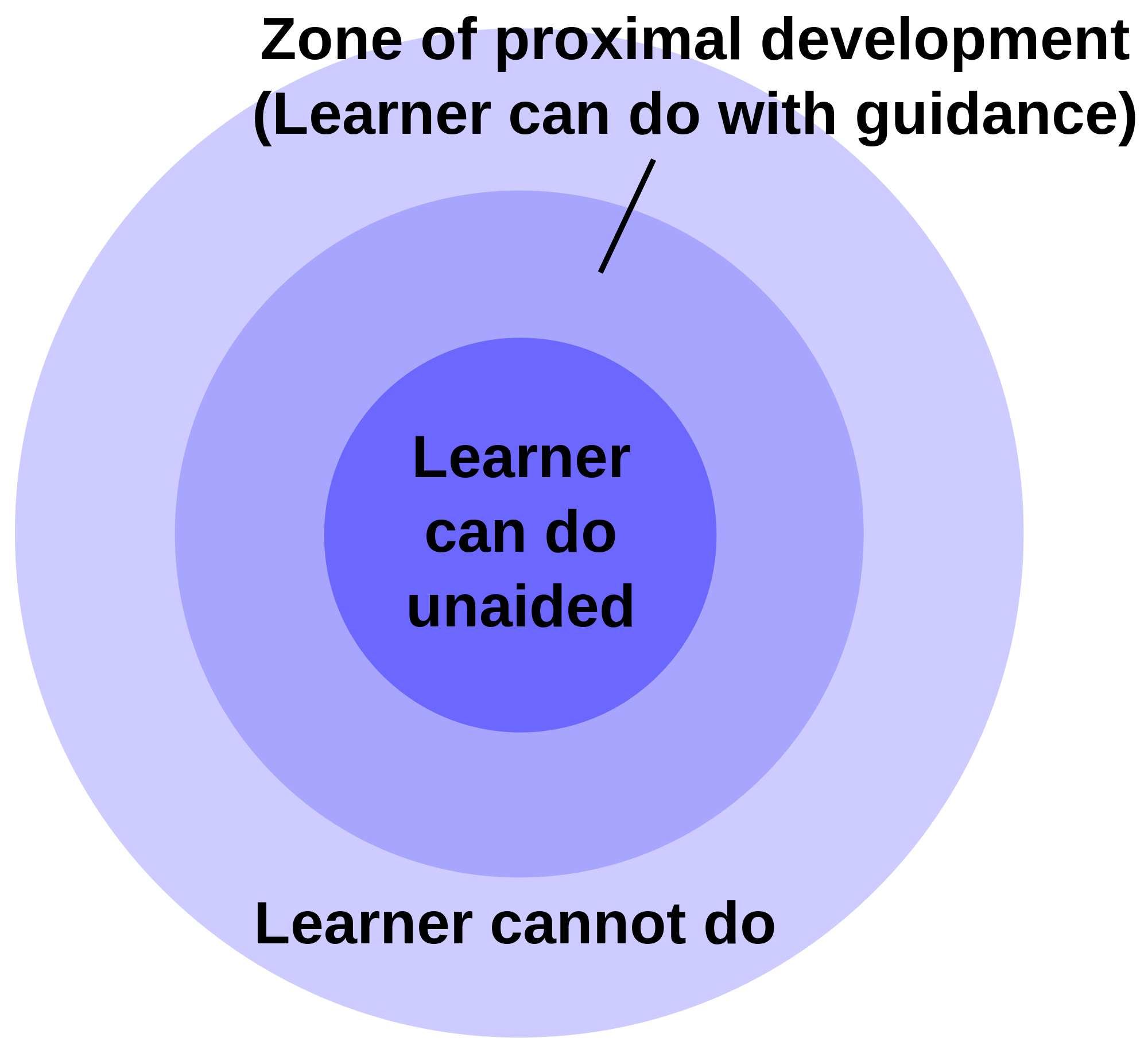
ideas. When Wilhelm (2014) starts talking about Vygotsky's Zone of
Proximal Development (ZPD) he states, "When you assign a task and the
students successfully complete it without help, they could already do it. They
have learned nothing" (p.16). To me this is such a vital piece of
information because it is a pitfall that I wish to avoid. The zone of
proximal development is predicated on a teacher providing assistance to a
student to help them master a new skill, and to then have the student be able
to enact that new skill on their own. When teachers give these
assignments and the students complete it without assistance, they have to be
aware that the student might have not learned anything.
As a
future educator, I enjoyed reading this chapter because it furthered my
knowledge on the Vygotskian Theory. I obviously knew some things about
Vygotsky and his theories, but Wilhelm goes in depth and provides useful
snapshots of his own personal experiences to really illustrate Vygotsky's
ideas. When Wilhelm (2014) starts talking about Vygotsky's Zone of
Proximal Development (ZPD) he states, "When you assign a task and the
students successfully complete it without help, they could already do it. They
have learned nothing" (p.16). To me this is such a vital piece of
information because it is a pitfall that I wish to avoid. The zone of
proximal development is predicated on a teacher providing assistance to a
student to help them master a new skill, and to then have the student be able
to enact that new skill on their own. When teachers give these
assignments and the students complete it without assistance, they have to be
aware that the student might have not learned anything.
Chapter 2 was also a really great chapter because it delved deep into reading
literacy and various techniques to teach reading. Wilhelm stresses that English
teachers have to teach students how to read, and how to read effectively.
I love how this chapter opened up with Jack's poem as a cry for help.
Jack would like to read, but he exclaims that no one has taught him how
to do so. Jack's story was illuminating for me because it is indicative that
not everybody has certain literacies, so I cannot automatically assume that a
student is literate in reading. These students may genuinely find it
difficult to engage with a text.
Again
Wilhelm offers yet another golden nugget that I am putting in my teacher
toolbox. In the section called "Guided Reading" it states that
"when you want students to learn something new, make sure everything else
is easy" (Wilhelm, 2001, p. 44). To me this makes sense, but it is
not something that would be in the forefront of my mind when constructing a
lesson plan. So, this has made me realize that everything involved in a
lesson is equally important. If I want a student to learn something then I have
to create an environment where they will be able to succeed. Also, in the
"Guided Reading" section Wilhelm discusses the importance of text
selection and according to him, choosing a text should prompt further learning
within that text, but should also provide a learning where students can carry
over to different texts (p.44). So, what I believe Wilhelm is trying to say is
that teaching reading strategies are more important than teaching the text.
Wilhelm also suggests that the students should have an interest in the
text they are reading. Someone should have handed this chapter to some of
my former high school English teachers. I just remember reading some of
the most boring and awful books in 12th grade English, specifically. Now
that I am currently in these teacher education courses, I often think back to
some of the teachers I have had and analyze their teaching from a different
perspective. There were some who knew how to teach effectively, but I am
afraid that most of my English teachers were the type to pick a book and assign
reading, and that was about it. I did not really have an English teacher
that taught the class how to read more academically, but I had those that would
assign a pop quiz asking to ID a quote somewhere on page 339. I refuse to
be like that.

I am glad that I read your post because with all of the important information given in these two chapters, I had not taken note of Wilhelm's statement about making everything else easy when you want a student to learn something new. This is definitely something that I will try to keep in mind while lesson planning. When you talk about looking back on some of your own experiences in high school after taking these teacher education courses, I can totally relate. I also had to read boring books and take pop quizzes that asked about very specific details. This is what probably led me to dislike English class. In classes other than English, I remember a lot of lecturing follow by memorization and a test. I would not want to subject my students to that kind of learning and I am glad we are taking these education courses that are teaching us how to do be better teachers than that.
ReplyDeleteHey Alex,
ReplyDeleteI really didn't realize the whole aspect of " Making everything else easy when you want a student to learn something new." I am still trying to comprehend as to how to incorporate that into lesson planning but I can imagine how a student can feel. If all of the material is way too hard to understand many of the times a student can just opt out and blank out in class. Although, I guess it is a battle of trying to get the right balance of information to learn and what is already mastered. This is where I think Vygotsky may have came up with the Zone of Proximal Development.
You hit home with being a teacher who only assigns reading. Being an English teacher of this day and age involves using different types of media in order to convey reading materials. I think the education system is trying to abolish this kind of teaching. And that is where innovative English teachers like you and I come in :)