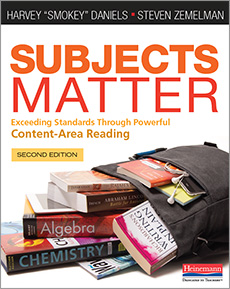
In chapter one, Daniels and Zemelman lay
the foundation for what they are trying to accomplish in the book, Subjects Matter, and the main focus is
creating better and more engaged readers. Subjects
Matter is primarily concerned with, "effectively inviting kids to
engage in our subjects, to think, remember, build knowledge-and to care"
(Daniels and Zemelman, 2014, p.9). This is the reason why we are immediately
plunged into the story of two high school students who were so invested into their
research on fast food chains that they went to an actual McDonald's and
vocalized their concerns, in front of diners and management, about the quality
and processing of the meat being served. All of this started because they were
presented with an opportunity to read and research something that affects their
lives. I believe that Daniels and
Zemelman are proponents of teachers that implement readings that resemble what
people read in their everyday lives, and this book mentions at various points
that in order to align with the Common Core State Standards, teachers must
utilize more nonfiction pieces. By opening the book with the fast food research
example, Daniels and Zemelman sets the stage for what types of reading children
should be doing in school. Daniels and Zemelman also stress that teachers
should avoid the 'Read this for Friday" type of reading.
 In my own experience, most of the reading
I did in high school mirrors the "Read this for Friday type" where
the teacher would assign an excruciatingly long chapter of a textbook to be
read for the next day. Here comes the following day, and surprise there is a
pop quiz. I will be the first person to say that textbook reading is absolutely
awful! I did not mind reading for English (and perhaps this why I am an English
major) because most of the time it we read stories that was different than the
difficult and complicated text that exists within a textbook. I am truly amazed
at publishers who put forth textbooks specifically for high school students,
but fail to take into account the likelihood of students actually reading
it. When it came to science classes I
had to take, it was hard for me to read through a chapter because there was so
much I did not know, so I became frustrated and ultimately daydreamed during
the reading. Then the teacher wanted us to take what we learned from the
textbook and conduct an experiment; I didn't know what I was doing. But, I guess that is the case Zemelman and
Daniels are trying to make in this book. We shouldn't necessarily get rid of textbooks
completely, but as teachers we need to show students how to pick out the most
important parts and we need to pair that with more self-selected nonfiction
pieces to boost reading skills. The key is teaching the students how to read
rather than just assigning the reading, which is a concept I had to wrap my mid
around a few times.
In my own experience, most of the reading
I did in high school mirrors the "Read this for Friday type" where
the teacher would assign an excruciatingly long chapter of a textbook to be
read for the next day. Here comes the following day, and surprise there is a
pop quiz. I will be the first person to say that textbook reading is absolutely
awful! I did not mind reading for English (and perhaps this why I am an English
major) because most of the time it we read stories that was different than the
difficult and complicated text that exists within a textbook. I am truly amazed
at publishers who put forth textbooks specifically for high school students,
but fail to take into account the likelihood of students actually reading
it. When it came to science classes I
had to take, it was hard for me to read through a chapter because there was so
much I did not know, so I became frustrated and ultimately daydreamed during
the reading. Then the teacher wanted us to take what we learned from the
textbook and conduct an experiment; I didn't know what I was doing. But, I guess that is the case Zemelman and
Daniels are trying to make in this book. We shouldn't necessarily get rid of textbooks
completely, but as teachers we need to show students how to pick out the most
important parts and we need to pair that with more self-selected nonfiction
pieces to boost reading skills. The key is teaching the students how to read
rather than just assigning the reading, which is a concept I had to wrap my mid
around a few times. 
Another important part of Chapter One is
the section on reading and the Common Core, and how it affects every content
teacher in the curriculum. The Common
Core Standards make it so that, "we are all teachers of reading now"
(Daniels and Zemelman, 2014, p. 14).
First of all, reading all about these CCSS makes my head spin. Whoever
said teaching was an easy profession was obviously under the wrong impression.
However, the CCSS alleviates a little bit of stress because it divides the
responsibility of teaching reading throughout the curriculum. As a future
English teacher, I know that I will be mostly responsible for reading literacy,
but it is nice that other teachers from different contents will also
contribute.
 Chapter Two of the book, "How Smart
Readers Think," focuses on the cognitive processes that are involved in
the act of reading. I liked how this chapter illuminates the importance of background
knowledge in reading. Daniels and Zemelman (2014) concur that, "Knowing
prior knowledge is the strongest determinant of understanding, and that new
knowledge can only be built upon existing knowledge..."(p.41). I really
love the concept of "the Columbus Key." In the book there is a very ambiguous passage
about Columbus's voyage. When I read
this passage the first time I had no idea that it was about Christopher Columbus
and his voyage. However, when the
authors provided the clue of "Christopher Columbus," I reread the
same passage and completely understood it. The authors did not translate the
passage word for word; they just provided one crucial piece that would make me
comprehend the reading. This really put everything into perspective for
me. One simple word like
"Columbus" could activate a whole world of existing background
knowledge that would allow me to comprehend the passage. D&Z describe this as activating existing
schemata, a web of knowledge that we construct on just about everything. I
think that every teacher should realize the power of a “Columbus Key.” Now, I
may not be teaching Columbus, but I could very well possess a “Shakespeare Key”
that could unlock students' ability to comprehend an assignment. One simple aid
can result in significantly positive results. I know I'll be making sure that I
have a "Columbus Key" for all my lessons.
Chapter Two of the book, "How Smart
Readers Think," focuses on the cognitive processes that are involved in
the act of reading. I liked how this chapter illuminates the importance of background
knowledge in reading. Daniels and Zemelman (2014) concur that, "Knowing
prior knowledge is the strongest determinant of understanding, and that new
knowledge can only be built upon existing knowledge..."(p.41). I really
love the concept of "the Columbus Key." In the book there is a very ambiguous passage
about Columbus's voyage. When I read
this passage the first time I had no idea that it was about Christopher Columbus
and his voyage. However, when the
authors provided the clue of "Christopher Columbus," I reread the
same passage and completely understood it. The authors did not translate the
passage word for word; they just provided one crucial piece that would make me
comprehend the reading. This really put everything into perspective for
me. One simple word like
"Columbus" could activate a whole world of existing background
knowledge that would allow me to comprehend the passage. D&Z describe this as activating existing
schemata, a web of knowledge that we construct on just about everything. I
think that every teacher should realize the power of a “Columbus Key.” Now, I
may not be teaching Columbus, but I could very well possess a “Shakespeare Key”
that could unlock students' ability to comprehend an assignment. One simple aid
can result in significantly positive results. I know I'll be making sure that I
have a "Columbus Key" for all my lessons.
Alex -
ReplyDeleteI completely agree with you when you say that textbooks seem to not be written with high school students reading them in mind! I recently picked up a couple of high school textbooks from the library just to refresh my memory on what reading for classes in high school was like and they were just terrible! I love the idea of giving students material to read that was written to be read, if that makes sense.
Alex, I can relate to your experience with a science class textbook. I am also an English content major so I love reading. But reading textbooks - not so much. I think it would be helpful if teachers in other subjects taught students how to read content specific literature, such as Math or History books, which is what Daniels and Zemelman stress. It takes different skills or techniques sometimes for students to grasp unfamiliar material. Incorporating supplemental reading material, like professional journals or magazine articles, are worth considering so textbooks are not the only source of information.
ReplyDelete