Sunday, February 22, 2015

Central Falls Scavenger Hunt


#1. What is the name of the oldest health care provider in Central Falls?
The oldest health care provider is Notre Dame Hospital on Broad Street. It used to be a fully functional hospital for years until it merged with Memorial Hospital of Pawtucket, RI, and now acts as an urgent care center. Did you know you could distinguish a city from a town in Rhode Island by looking to see who has a hospital? Yes, if the location has a hospital, it is officially considered a city. 

#4. How many schools are in the city? Colleges and Universities?
There are 6 schools in the Central Falls School Department, and they are--Captain Hunt Learning (PK), Margaret Robertson Elementary, Ella Risk Elementary, Veterans Memorial Elementary, Calcutt Middle School, and Central Falls High School.

#6. Where is the satellite office of one of the oldest Child Welfare agencies in the city?
The name is Children's Friend, and is located on 621 Dexter Street. Not only is it the oldest Child Welfare agency in the city, but also it is the oldest in the entire state. 

#8. Central Falls Post Office
#8. Is there a post office in town?
Yes, of course there is a post office in town, and it can be found on busy Dexter Street. 
#9. Is there a fire station? A Police Station How are fire emergencies handled? What crime statistics are available for the community?

Emergencies are handled by dialing 9-1-1. Okay, so that was a no brainer, but Central Falls does have a police station and a fire station, side by side. Even though, Central Falls is only a square mile big, it is still considered a city, so they obviously have a fully functional police and fire department. Crime statistics can be obtained at the police station, or by obviously using a computer. 
#12. The back entrance to Jenk's Park

#12. Are there public parks?
Yes, and there's a lot more than I expected. Central Falls is home to Jenk's Park, River Island Park, Peirce Park, and Lewis and Hunt Park. It sounds like residents have plenty of options. 


#18. What is the major religion in the city/town?

#18. Holy Trinity Complex (St. Matthews)
The major religion, in Central Falls, is Roman Catholic, and there are many churches within the city. The churches include, Holy Spirit Parish (formerly known as St. Matthew's Church), New Life Church, Holy Trinity Complex, Holy Cross Catholic Church, and Bible Baptist Church.

#22. The first mayor looks down from his perch as students come into the school.
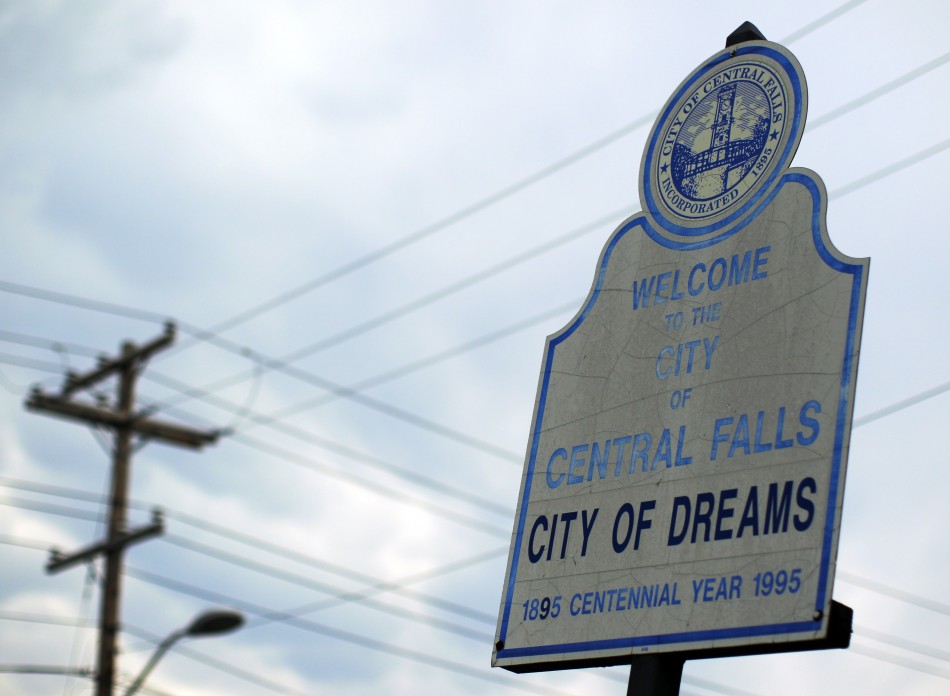
Well, the first mayor of Central Falls is Charles Moies who was elected in 1895. I was trying to capture a picture of this mayor, but I could not find him. Maybe, I wasn't looking hard enough, but I am just going to assume he took a much-needed vacation. 

#24. There are three professional baseball players from Central Falls. Name them.
Who knew Central Falls was so famous? I love it! It makes me proud to be a very close neighbor to this incredible city. The three professional baseball players from Central Falls are Max Surkont, who is most notable for his time with the Milwaukee Braves. Then there is Jim Siwy who actually played baseball for Central Falls High School before making it to the Chicago White Sox. Finally there is Charley Bassett who made it big back in the late 1800's, definitely old school.

#26. Cogswell's Tower

#26. Becoming wealthy during the Gold Rush of 1849, she remembered her hometown and donated $50,000 to build the most recognizable feature in the city. Everyone knows who she is and can see her donation...time after time. 


The monument is called the Cogswell Tower named after Caroline Cogswell. First of all, $50,000 was probably an insane amount of money in the 1800s, and to build a giant clock like that only means that Cogswell's pockets must have been pretty deep. 


Reflection:
      I actually found myself enjoying this scavenger hunt. Growing up as a Pawtucket native, Central Falls was always the city over the bridge, but after completing this assignment, I have grown to appreciate the smallest city in the country, a tremendous amount more.  I learned that every city has rich history, and Central Falls, especially, is bursting with legacy and culture.  While partaking in this Scavenger Hunt, I kept thinking about my city and history and landmarks within it. I realized that this history has somehow been woven into my upbringing, whether it was school field trips to Slater Mill, or enjoying a sunny day at Slater Park. The same applies to the residents of Central Falls, especially those that have been there for so long. This place means something to them, much more than just a residency. It is where memories can be created. It is this aspect that leads me to my questions. I want to know where people hang out, or what the people really think about the giant clock propped upon the hill, next to the high school. What emotions/memories do these places and monuments evoke? This scavenger will definitely help me in my career as a future teacher because it has taught me that I need to get to know the city/town in which I am teaching. This will help me better understand my students and the place that I will have to call my educational home. It will help understand the community. 

Backwards Design and Understanding by Design (UbD)

Chapter one, “What is Backwards Design?” immediately opens up with the statement that, “teachers are designers” (p. 7).  My first thought was, “Great, now I have to be an architect along with everything else I need to be as a teacher.” However, as I read the chapter, I came to realize that backwards design makes sense. It’s simple, backwards design is predicated on three things—start with an objective, choose assessment methods, and then, finally, plan the lessons and activities.  Basically, every unit should be framed around the objective/goal, which is usually a Common Core State Standard or a content standard.  By framing units in this way, the desired result is more likely to be achieved. It is discussed, within the chapter, that many teachers make the mistake by starting with a topic or the textbook without fully planning (“designing”) their units. This resonated with me, for I do not wish to be this kind of teacher. It’s like going into your lesson plan blind, so to speak, with no map. Just think about how much time will be diverted by having to stop and readjust your unit because you go into it unprepared.  It’s like going on a road trip without knowing your desitnation, and I do not have time for that!

The 3 Stages of Backwards Design:
1. Identify Desired Results:
            - Start with the question: “what should students know, understand, and be able to do?”(p.9)
            - In this stage, I learned that choices would need to be made!
2. Determine Acceptable Evidence:
            -Use a variety of assessment methods.
            -A way to document that learning has been achieved in a unit (p.12).
3. Plan Learning experiences and Instruction
            -Keep in mind the key questions (i.e. “what activities will equip students with needed knowledge and skills?”) (P.13).

Why is this important to me as a future teacher?
Figure of The Three Nested Rings
            Well, in my opinion, stage one is the most important stage because it is where the unit is framed.  I know this will probably be the hardest stage for me because I need to choose the goal that will best benefit my students.  I need to keep in mind to choose specific content and concepts. For example, I will not be able to teach my students everything about Shakespeare, so in this stage, I need to figure out what concepts about Shakespeare are most important to teach. Sometimes, teacher try and take on too much, but with starting with an objective, it can help assure our teaching is encouraging understanding. The concept of the 3 nested rings also put things into perspective, especially the part that introduced the concept of “enduring understandings.” Our goal is, “to pick the grain choices that will anchor the unit” (p.10). The key is to teach for enduring understanding, so the goals should be based on what students should be able to retain.

            I think of assessments as checkpoints in the lesson plan/unit. This is where you check to see if students understand what they are learning.  I need to remember to provide multiple ways to assess. This not only corroborates with Gardner’s multiple intelligences, but it lead to enduring understanding.

By using the key questions one can assess their unit plan and determine whether or not activities are matching up with the end result. I must choose activities that will build upon the understanding and knowledge that will progress my students to the objective. I can’t be choosing lessons and activities because I like them, but rather I need to choose activities that are meaningful and will actually contribute to my students reaching their goal.

Modules A and F:
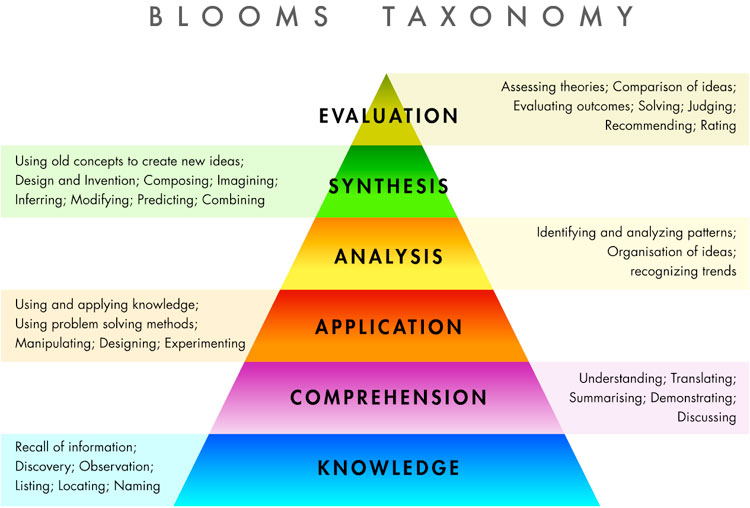
            Module A provides the foundations for UbD, and it really coincides and reiterates the concepts of backwards design. The reason why UbD is important is because, “[it] is predicated on the idea that long-term achievement gains are more likely when teachers teach for understanding of transferable concepts and processes while giving the learners multiple opportunities to apply their learning in meaningful contexts”(p.4.). The best way to achieve this is to simultaneously use the principles laid out in backwards design while using Bloom’s Taxonomy.  Bloom’s Taxonomy of the Cognitive Domain is primarily concerned with the individual’s ability to apply their learning to other aspects. Therefore, I think it is best to create objectives and goals that are classified in the higher level thinking orders of Bloom’s Taxonomy when beginning UbD or Backwards Design.

            Another piece of information that I hold onto is that, “understanding underlying concepts and principles is more effective than relying on memory” (p.5). Activities that rely on the recall of facts are not producing effective learners.  The module also includes a sin to avoid while teaching in the secondary level, and that is to avoid content coverage, “plowing through the textbook” (p.8).  We need to make sure we are using the textbook effective, and that means to avoid the textbook being the only source to go to in the classroom.


            Module F is concerned with Essential Questions and Understanding. Basically, as teachers, we need to create thought provoking questions to avoid superficial answers that rely on memory recall. These essential questions should be open ended, allowing the possibility for a plethora of questions; this is known as in-depth inquiry (p.76). For me, I think essential questions are important because they will help facilitate the lesson plan, and it will contribute to the students acquiring concepts rather than skills. Concepts versus skill essential questions are also mentioned in this module, and that some content areas allow for better concept based essential questions.  As and English major, I can’t help but think of questions as concept-based.  A big part of ELA is examining text in an in-depth way, but I can see where a math class, which relies on skill, would have a tough time create these essential questions.

Sunday, February 8, 2015

Behold, "The Columbus Key" (D&Z Chapters 1-2)

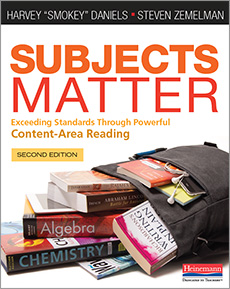
In chapter one, Daniels and Zemelman lay the foundation for what they are trying to accomplish in the book, Subjects Matter, and the main focus is creating better and more engaged readers. Subjects Matter is primarily concerned with, "effectively inviting kids to engage in our subjects, to think, remember, build knowledge-and to care" (Daniels and Zemelman, 2014, p.9). This is the reason why we are immediately plunged into the story of two high school students who were so invested into their research on fast food chains that they went to an actual McDonald's and vocalized their concerns, in front of diners and management, about the quality and processing of the meat being served. All of this started because they were presented with an opportunity to read and research something that affects their lives.  I believe that Daniels and Zemelman are proponents of teachers that implement readings that resemble what people read in their everyday lives, and this book mentions at various points that in order to align with the Common Core State Standards, teachers must utilize more nonfiction pieces. By opening the book with the fast food research example, Daniels and Zemelman sets the stage for what types of reading children should be doing in school. Daniels and Zemelman also stress that teachers should avoid the 'Read this for Friday" type of reading.

In my own experience, most of the reading I did in high school mirrors the "Read this for Friday type" where the teacher would assign an excruciatingly long chapter of a textbook to be read for the next day. Here comes the following day, and surprise there is a pop quiz. I will be the first person to say that textbook reading is absolutely awful! I did not mind reading for English (and perhaps this why I am an English major) because most of the time it we read stories that was different than the difficult and complicated text that exists within a textbook. I am truly amazed at publishers who put forth textbooks specifically for high school students, but fail to take into account the likelihood of students actually reading it.  When it came to science classes I had to take, it was hard for me to read through a chapter because there was so much I did not know, so I became frustrated and ultimately daydreamed during the reading. Then the teacher wanted us to take what we learned from the textbook and conduct an experiment; I didn't know what I was doing.  But, I guess that is the case Zemelman and Daniels are trying to make in this book. We shouldn't necessarily get rid of textbooks completely, but as teachers we need to show students how to pick out the most important parts and we need to pair that with more self-selected nonfiction pieces to boost reading skills. The key is teaching the students how to read rather than just assigning the reading, which is a concept I had to wrap my mid around a few times.
Another important part of Chapter One is the section on reading and the Common Core, and how it affects every content teacher in the curriculum.  The Common Core Standards make it so that, "we are all teachers of reading now" (Daniels and Zemelman, 2014, p. 14).  First of all, reading all about these CCSS makes my head spin. Whoever said teaching was an easy profession was obviously under the wrong impression. However, the CCSS alleviates a little bit of stress because it divides the responsibility of teaching reading throughout the curriculum. As a future English teacher, I know that I will be mostly responsible for reading literacy, but it is nice that other teachers from different contents will also contribute.

Chapter Two of the book, "How Smart Readers Think," focuses on the cognitive processes that are involved in the act of reading. I liked how this chapter illuminates the importance of background knowledge in reading. Daniels and Zemelman (2014) concur that, "Knowing prior knowledge is the strongest determinant of understanding, and that new knowledge can only be built upon existing knowledge..."(p.41). I really love the concept of "the Columbus Key."  In the book there is a very ambiguous passage about Columbus's voyage.  When I read this passage the first time I had no idea that it was about Christopher Columbus and his voyage.  However, when the authors provided the clue of "Christopher Columbus," I reread the same passage and completely understood it. The authors did not translate the passage word for word; they just provided one crucial piece that would make me comprehend the reading. This really put everything into perspective for me.  One simple word like "Columbus" could activate a whole world of existing background knowledge that would allow me to comprehend the passage.  D&Z describe this as activating existing schemata, a web of knowledge that we construct on just about everything. I think that every teacher should realize the power of a “Columbus Key.” Now, I may not be teaching Columbus, but I could very well possess a “Shakespeare Key” that could unlock students' ability to comprehend an assignment. One simple aid can result in significantly positive results. I know I'll be making sure that I have a "Columbus Key" for all my lessons.