Chapter one, “What is Backwards Design?” immediately opens
up with the statement that, “teachers are designers” (p. 7). My first thought was, “Great, now I have to
be an architect along with everything else I need to be as a teacher.” However,
as I read the chapter, I came to realize that backwards design makes sense.
It’s simple, backwards design is predicated on three things—start with an
objective, choose assessment methods, and then, finally, plan the lessons and
activities. Basically, every unit should
be framed around the objective/goal, which is usually a Common Core State
Standard or a content standard. By
framing units in this way, the desired result is more likely to be achieved. It
is discussed, within the chapter, that many teachers make the mistake by
starting with a topic or the textbook without fully planning (“designing”)
their units. This resonated with me, for I do not wish to be this kind of teacher.
It’s like going into your lesson plan blind, so to speak, with no map. Just
think about how much time will be diverted by having to stop and readjust your
unit because you go into it unprepared. It’s like going on a road trip without knowing
your desitnation, and I do not have time for that!
The 3 Stages of Backwards Design:
1. Identify Desired Results:
- Start
with the question: “what should students know, understand, and be able to do?”(p.9)
- In this
stage, I learned that choices would need to be made!
2. Determine Acceptable Evidence:
-Use a
variety of assessment methods.
-A way to
document that learning has been achieved in a unit (p.12).
3. Plan Learning experiences and Instruction
-Keep in
mind the key questions (i.e. “what activities will equip students with needed
knowledge and skills?”) (P.13).
Why is this important to me
as a future teacher?
 |
| Figure of The Three Nested Rings |
Well,
in my opinion, stage one is the most important stage because it is where the
unit is framed. I know this will
probably be the hardest stage for me because I need to choose the goal that
will best benefit my students. I need to
keep in mind to choose specific content and concepts. For example, I will not
be able to teach my students everything about Shakespeare, so in this stage, I
need to figure out what concepts about Shakespeare are most important to teach.
Sometimes, teacher try and take on too much, but with starting with an
objective, it can help assure our teaching is encouraging understanding. The
concept of the 3 nested rings also put things into perspective, especially the
part that introduced the concept of “enduring understandings.” Our goal is, “to
pick the grain choices that will anchor the unit” (p.10). The key is to teach
for enduring understanding, so the goals should be based on what students
should be able to retain.
I think of
assessments as checkpoints in the lesson plan/unit. This is where you check to
see if students understand what they are learning. I need to remember to provide multiple ways
to assess. This not only corroborates with Gardner’s multiple intelligences,
but it lead to enduring understanding.
By using the key questions one can assess
their unit plan and determine whether or not activities are matching up with
the end result. I must choose activities that will build upon the understanding
and knowledge that will progress my students to the objective. I can’t be
choosing lessons and activities because I like them, but rather I need to
choose activities that are meaningful and will actually contribute to my
students reaching their goal.
Modules A and F:
Module A
provides the foundations for UbD, and it really coincides and reiterates the
concepts of backwards design. The reason why UbD is important is because, “[it]
is predicated on the idea that long-term achievement gains are more likely when
teachers teach for understanding of transferable concepts and processes while
giving the learners multiple opportunities to apply their learning in
meaningful contexts”(p.4.). The best way to achieve this is to simultaneously
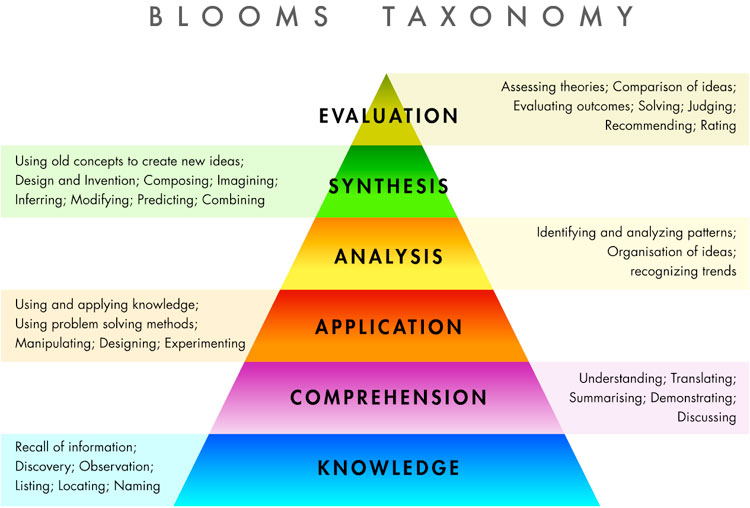
use the principles laid out in backwards design while using Bloom’s Taxonomy. Bloom’s Taxonomy of the Cognitive Domain is
primarily concerned with the individual’s ability to apply their learning to
other aspects. Therefore, I think it is best to create objectives and goals
that are classified in the higher level thinking orders of Bloom’s Taxonomy
when beginning UbD or Backwards Design.
Another
piece of information that I hold onto is that, “understanding underlying
concepts and principles is more effective than relying on memory” (p.5).
Activities that rely on the recall of facts are not producing effective learners. The module also includes a sin to avoid while
teaching in the secondary level, and that is to avoid content coverage,
“plowing through the textbook” (p.8). We
need to make sure we are using the textbook effective, and that means to avoid
the textbook being the only source to go to in the classroom.
 Module F is
concerned with Essential Questions and Understanding. Basically, as teachers,
we need to create thought provoking questions to avoid superficial answers that
rely on memory recall. These essential questions should be open ended, allowing
the possibility for a plethora of questions; this is known as in-depth inquiry
(p.76). For me, I think essential questions are important because they will
help facilitate the lesson plan, and it will contribute to the students
acquiring concepts rather than skills. Concepts versus skill essential
questions are also mentioned in this module, and that some content areas allow
for better concept based essential questions.
As and English major, I can’t help but think of questions as
concept-based. A big part of ELA is examining
text in an in-depth way, but I can see where a math class, which relies on
skill, would have a tough time create these essential questions.
Module F is
concerned with Essential Questions and Understanding. Basically, as teachers,
we need to create thought provoking questions to avoid superficial answers that
rely on memory recall. These essential questions should be open ended, allowing
the possibility for a plethora of questions; this is known as in-depth inquiry
(p.76). For me, I think essential questions are important because they will
help facilitate the lesson plan, and it will contribute to the students
acquiring concepts rather than skills. Concepts versus skill essential
questions are also mentioned in this module, and that some content areas allow
for better concept based essential questions.
As and English major, I can’t help but think of questions as
concept-based. A big part of ELA is examining
text in an in-depth way, but I can see where a math class, which relies on
skill, would have a tough time create these essential questions. 
No comments:
Post a Comment